Think in cycles
Separate short-term volatility from the long-term forces that shape markets across decades.
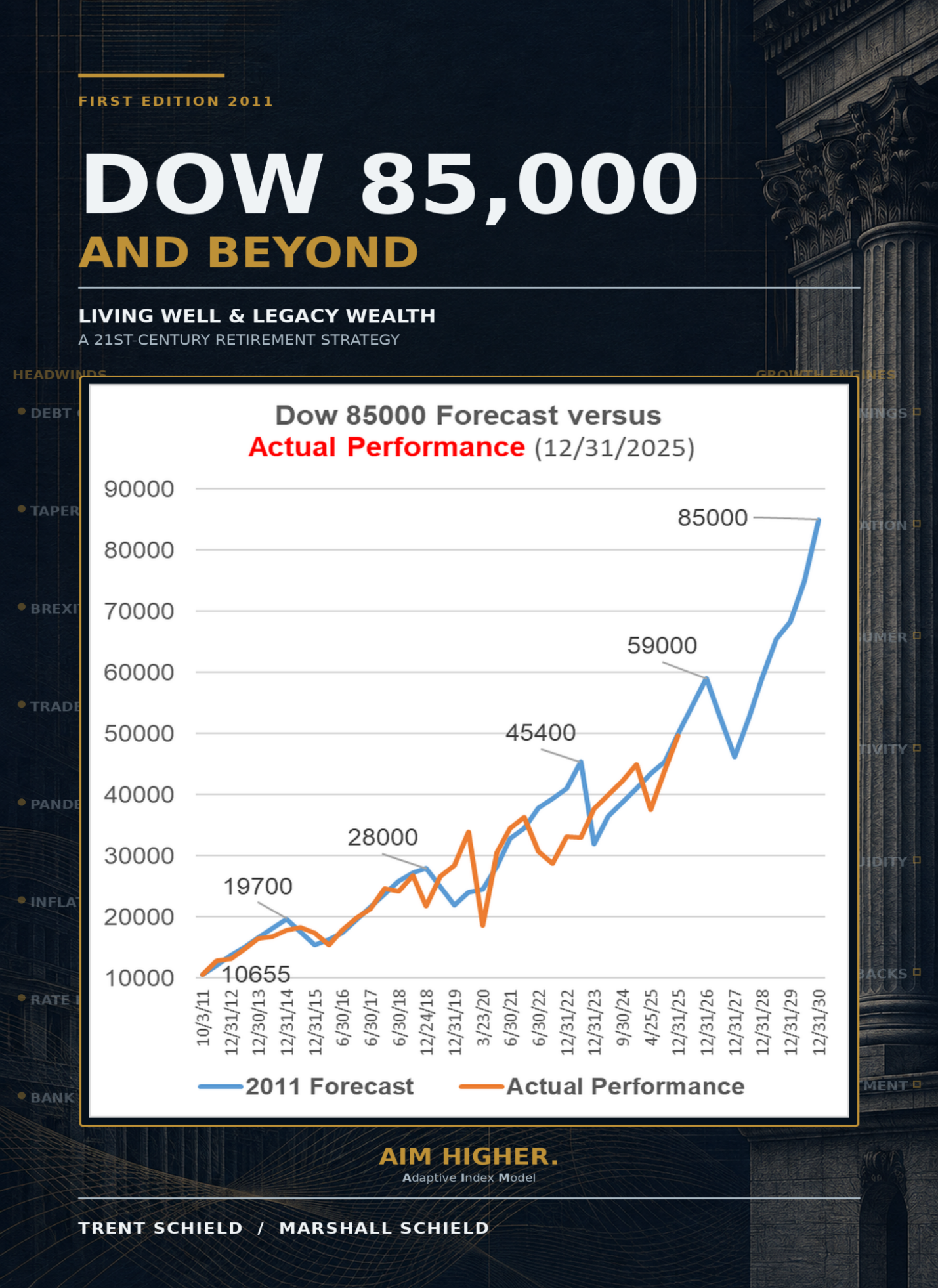
A market forecast published in 2013
More than a number, it was a case for thinking in decades—not headlines—and recognizing the power of secular market cycles.
The original argument
“The decade of poor performance is behind us.”
After a difficult decade for stocks, the book argued that a new secular bull market had begun—one that could persist through multiple cyclical advances, corrections and bear markets.
The point was never that markets would travel upward without interruption. The point was to recognize the larger cycle, stay invested with discipline and seek ways to participate more fully while respecting risk.
The journey so far
The Dow closed 2013 at 16,576.66. By September 2, 2026, it had reached 53,061.95—more than three-fifths of the way to the book’s 85,000 target.
Market figure as of September 2, 2026.
The enduring idea
Separate short-term volatility from the long-term forces that shape markets across decades.
Participation in advancing markets and disciplined risk management can matter more than any single forecast.
A secular bull contains corrections and cyclical bears. Progress is powerful precisely because it is not linear.
The challenge of the book was simple: understand the opportunity, build a process and aim higher.
The next chapter
The Adaptive Index Model
The original book asked investors to recognize a new secular bull market. The new manuscript asks the next question: How can investors use familiar index funds more fully across both rising and falling market cycles?
AIM Higher introduces an active, rules-based framework designed to adapt market exposure as trends change—seeking to participate more fully in opportunity while responding systematically to risk.
Explore the Adaptive Index ModelThe destination remains ahead
Return to the thesis. Measure it honestly. Learn from every cycle. And keep aiming higher.
Back to the beginning